 Back
Back
Locally led resilient rangelands
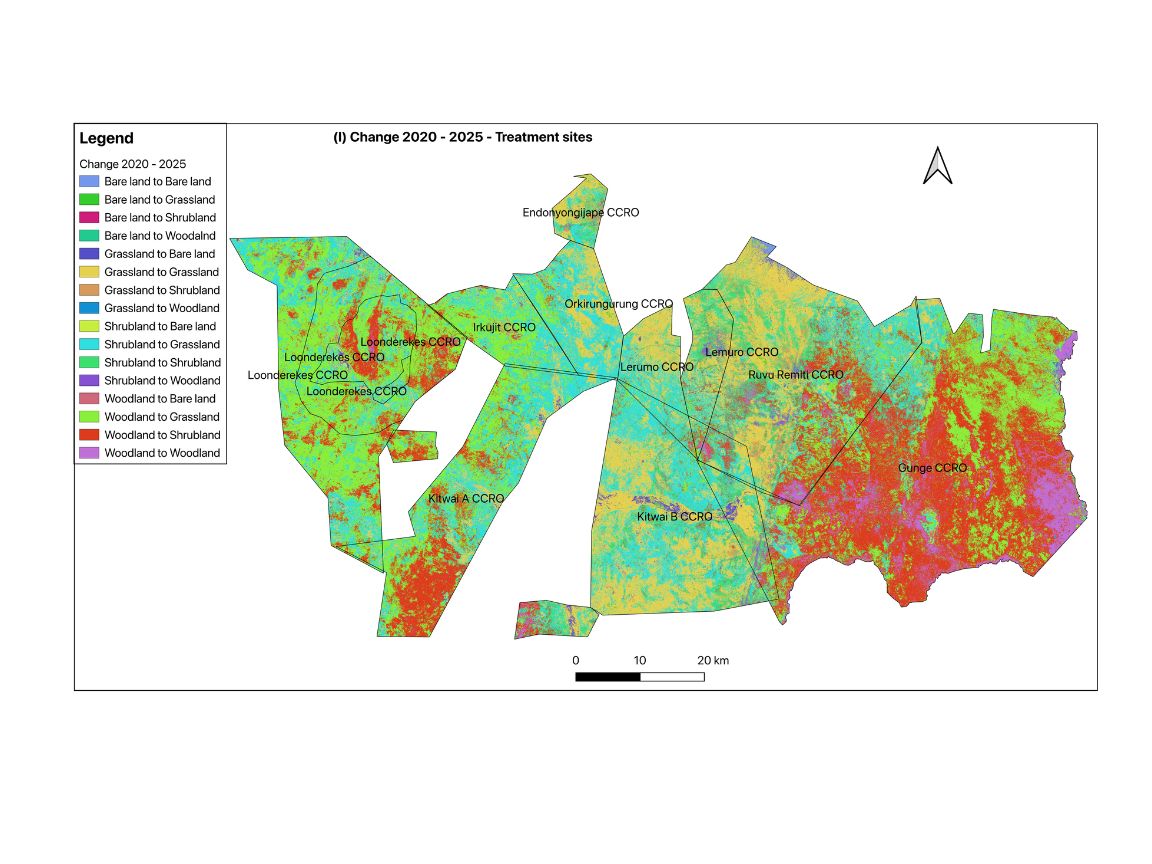
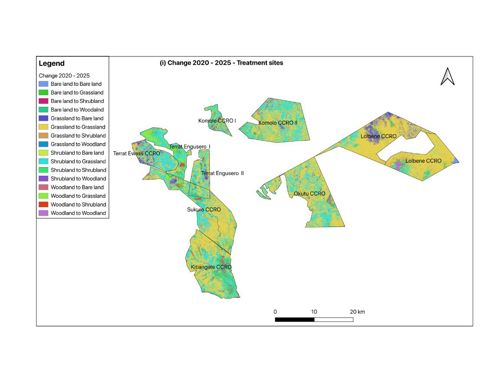
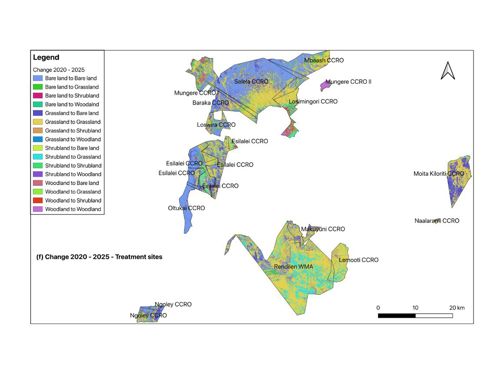
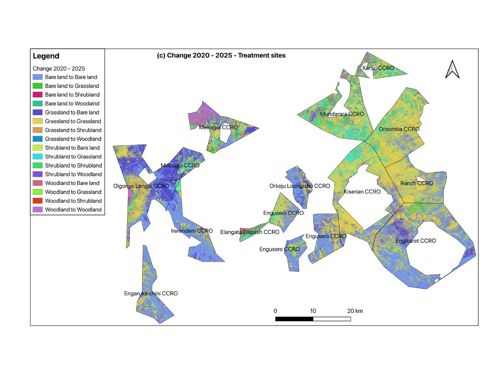
Vegetation cover change in project integrated rangeland management treatment villages - Simanjiro District. Credit - Dr. Richard Giliba (Nelson Mandela Africa Institute of Science and Technology).
Building Climate Resilience in Tanzania’s
Tarangire Rangelands
Across northern Tanzania’s Tarangire–Manyara ecosystem, communities live with rainfall that is both seasonal and increasingly unpredictable. Annual rainfall ranges from 400 to 800 mm and is followed by long, hot dry seasons in which temperatures often exceed 35 °C. These shifting climatic patterns directly affect pastoral and agro-pastoral households, whose wellbeing depends on healthy pastures and reliable water sources. Strengthening resilience in this landscape is therefore essential, both for biodiversity, and for helping rural communities withstand and adapt to growing climate stress.
Between 2022 and 2026, The Nature Conservancy, Tanzania People and Wildlife, Istituto Oikos, and the Ujamaa Community Resource Team worked across Monduli, Longido, Simanjiro, and Babati districts to strengthen Integrated Rangeland Management (IRM) as a foundation for climate adaptation. The project recognised that communities are better able to cope with climate shocks when rangelands remain healthy and governance systems support sustainable grazing. Through participatory planning, communities developed grazing zones, protected dry season reserves, and monitored pasture conditions more routinely. By the end of the project, villages reporting active rangeland management interventions had risen from 69.6% to 82.2%. Community members noted that rotational grazing helped them navigate drought years, by maintaining areas of standing grass that could be used during difficult periods.
Climate variability also affected project delivery. Prolonged dry spells made it harder to gather communities for grazing consultations, while unseasonal storms damaged roads and delayed fieldwork. These disruptions encouraged the project team to plan more flexibly around seasonal windows and to strengthen remote monitoring of vegetation and livestock movements. These adaptive approaches improved the project’s resilience to future climatic uncertainty, and reinforced the importance of flexibility in climate-exposed landscapes.
Ecological monitoring shows that strengthened governance translated into measurable landscape gains despite variable weather conditions. Between 2020 and 2025, grassland cover in IRM areas increased from 32.4% to 62.3%, and rangeland stability rose to 41.7% with minimal degradation.
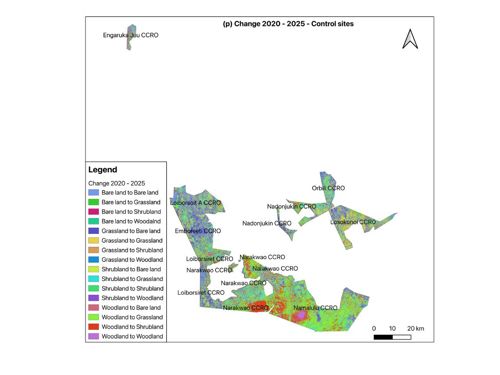
In contrast, control areas experienced a 23.2 percentage point increase in bare ground and a 36.0 pp point decline in woodland cover. These differences demonstrate that holistic planned grazing, and stronger community-led bylaw enforcement, had greater influence on vegetation health than rainfall alone. Healthy rangelands provide a natural buffer to climate‑related shocks, recover more quickly after dry periods, and support more reliable forage.
Some ecological challenges persisted. Ground surveys identified more than 71,000 ha affected by woody plant encroachment and invasive plant species including Vachellia nubica, Dichrostachys cinerea and Gutenbergia cordifolia. These species suppress grass growth and threaten long-term resilience unless they are controlled. The project therefore supported communities to strengthen the early detection and selective removal of these species, as well as shared monitoring responsibilities. This work recognises that controlling invasive species is essential for maintaining the adaptive capacity of rangelands.
Wildlife presence also increased across the landscape as habitat conditions improved. Elephant sightings were reported by 85.5% of respondents in treatment villages, and buffalo sightings were strongly associated with improved IRM areas. These trends reflect ecological recovery and the ability of village lands to support migratory species that are themselves vulnerable to human expansion and climate stress.
At the same time, recovery created new challenges. Human-wildlife conflict intensified, with increased livestock predation, crop raiding, and injuries to people compared to baseline levels. As drought intensifies in surrounding non-project areas, wildlife increasingly moves into the healthier IRM managed zones in search of forage and water. This is one of the complex trade-offs of building climate-resilient ecosystems, since improved habitat conditions can also attract wildlife into community areas.
Communities, however, demonstrated greater preparedness to manage these pressures. Reporting of wildlife incidents more than doubled, the use of friendly deterrents increased, and the number of households taking no action declined sharply. These shifts indicate stronger governance, improved institutional awareness and increased community capacity to respond to conservation-driven wildlife interactions.
Throughout the project, collaboration with district authorities and village governments ensured that seasonal grazing plans, bylaws, and monitoring systems aligned with broader land use policies. These partnerships support the continuation of IRM practices beyond the project period and provide a foundation for long-term adaptation under increasing climate uncertainty. From the outset, project design prioritised sustainability by investing in governance, nature-based solutions, and diversified livelihoods. These elements are essential for resilience in a rapidly changing climate.
Overall, the Tarangire–Manyara landscape demonstrates that building climate resilience requires healthy ecosystems, strong community institutions, and livelihood strategies that reduce vulnerability to climate shocks. This project helped catalyse improvements in vegetation stability, community preparedness, and governance capacity across a landscape deeply shaped by climate variability. Although challenges remain, including the spread of invasive species and rising human-wildlife conflict, the evidence shows that locally led rangeland management can shift ecological trajectories and strengthen the ability of people and nature to adapt to future climate change.
Written by Victor Nyambok and Philipo Lukumay. For more information on this Darwin Initiative Extra project DAREX004, led by TNC, click here.