 Back
Back
Indigenous climate solutions
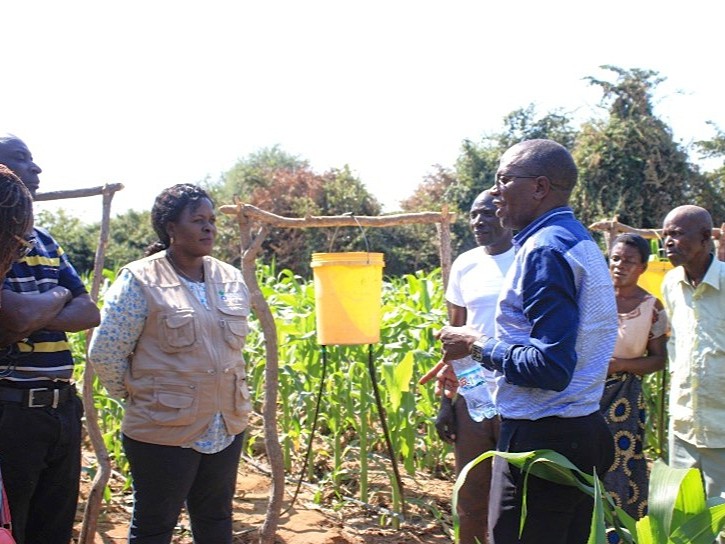
Bucket irrigation. Credit – Action Against Hunger Zambia.
When science failed, a twig showed the way: Lessons in building climate resilience and adaptation from the Zambezi watershed
The Challenge
Our project in Zambia was designed to strengthen the capacity of local NGOs in biodiversity conservation and poverty interventions within the Zambezi watershed. However, the severe 2023/2024 droughts, declared a national emergency by President Hakainde Hichilema, made it brutally clear that we could not achieve these goals by focusing on institutional capacity alone. The communities we served were facing starvation, and their immediate need for food and water overshadowed everything else, forcing us to fundamentally rethink our approach. This article shares our journey of weaving climate change adaptation into our project, and the profound lesson we learned from a local traditional pump minder when modern science failed us.
How we are building resilience: From dams to boreholes
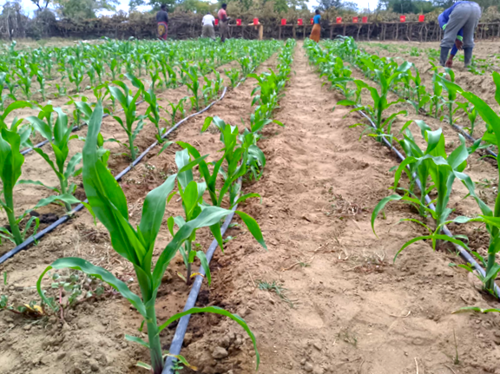
In Mukwalantila village of Zimba district, Southern Zambia, we helped communities respond to and recover from the drought. We initially introduced improved seed varieties, treadles pumps, and bucket drip irrigation kits to build the capacity of three local organisations. These solutions depended on surface water from community dams, which was siphoned or pumped using treadle pumps, generators, and/or just pipes. However, as the drought intensified, communities wisely prioritised the remaining water for drinking by people and livestock. Our capacity building activities for irrigation were cancelled as the dams quickly dried up completely.
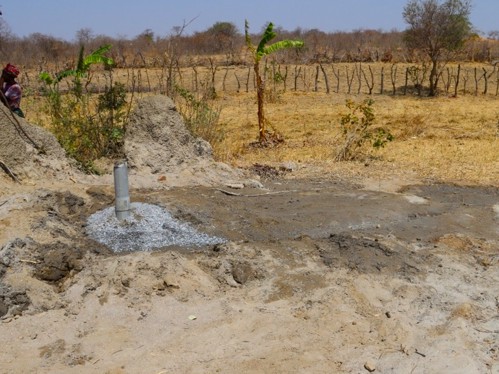
To save the crops and livelihoods, we had to pivot from surface water to a more climate-resilient source: underground water. This meant drilling a borehole, an activity completely outside our original project design. It was a direct response to a climate-driven emergency.
To save the crops and livelihoods, we had to pivot from surface water to a more climate-resilient source: underground water. This meant drilling a borehole, an activity completely outside our original project design. It was a direct response to a climate-driven emergency.
A turning point: The lesson in Indigenous Knowledge
Our first attempt to site the borehole used modern scientific methods. A trained engineer was engaged, and we drilled to a depth of 87 m. We found no water. It was a costly failure, and time was running out.
Frustrated, the host community made a request: allow a local traditional pump minder, Mr Edson Simutibule, to try. Using Indigenous Knowledge passed down from his father, Mr Simutibule walked the area with a Y-shaped twig (impanda) from a Mopane tree. To the amazement of the project team, he identified a spot just 20 m away from our failed 87 m borehole. We drilled there and found a reliable source of water at just 15 m, all the way to 50 m.
What did we learn?
This experience was a masterclass in climate adaptation. Mr Simutibule’s method is not superstition; it is a sophisticated system based on generations of observation. He uses:
- Drought-resistant tree species (Mopane, Ficus, Msekese), believing trees from harsh environments are better indicators.
- Natural indicators like ant behaviour, observing where they bring wet soil to the surface even in dry conditions.
- A precise technique: the stick bends towards water, and he can even estimate the depth.
His accuracy is rated at 95% by the Kalomo District Council, compared to the 50/50 success rate often cited for modern geophysical methods. Since we invited him to share his work at an Action Against Hunger evidence week three years ago, he has been hired across the country, most recently by African Parks to locate water for wildlife in Kazungula, saving them significant money after modern methods failed.
Future impact, design, and challenges
This event fundamentally changed how we view project design. We now understand that climate change adaptation must be locally-led and rooted in ancestral expertise. The biggest challenge we faced was not only the drought itself, but our own initial bias toward modern technology. We almost missed a solution that was right in front of us.
Looking ahead, our project’s impact on mitigating climate change is now linked to preserving this knowledge.
Voices from the community and influencing policy
The community now feels significantly more prepared and have continued to use the borehole and produce food all year round. They have reclaimed their heritage as a tool for survival. Furthermore, we have shared this experience with the Kalomo District Council, which has formally recognised Mr Simutibule’s accuracy. This has influenced local policy by creating a pathway for traditional practitioners to be consulted on infrastructure projects, enhancing climate resilience at a government level.
Conclusion
Our project in the Zambezi watershed learned that climate resilience is not just about technology and focusing on institutional capacity alone; it is about humility. When our modern borehole siting failed at 87 m, it was a less than 15 minute session from a man with a twig that saved the project and an entire community of over 100 households and their livestock. Building adaptable conservation efforts means unearthing, preserving, and leveraging Indigenous Knowledge alongside modern science.
Written by Mike Mukuwa, Action Against Hunger Zambia. For more information on this Darwin Initiative Capability & Capacity project DARCC024, led by Action Against Hunger UK, click here.