 Back
Back
Shifting stories for tiger conservation
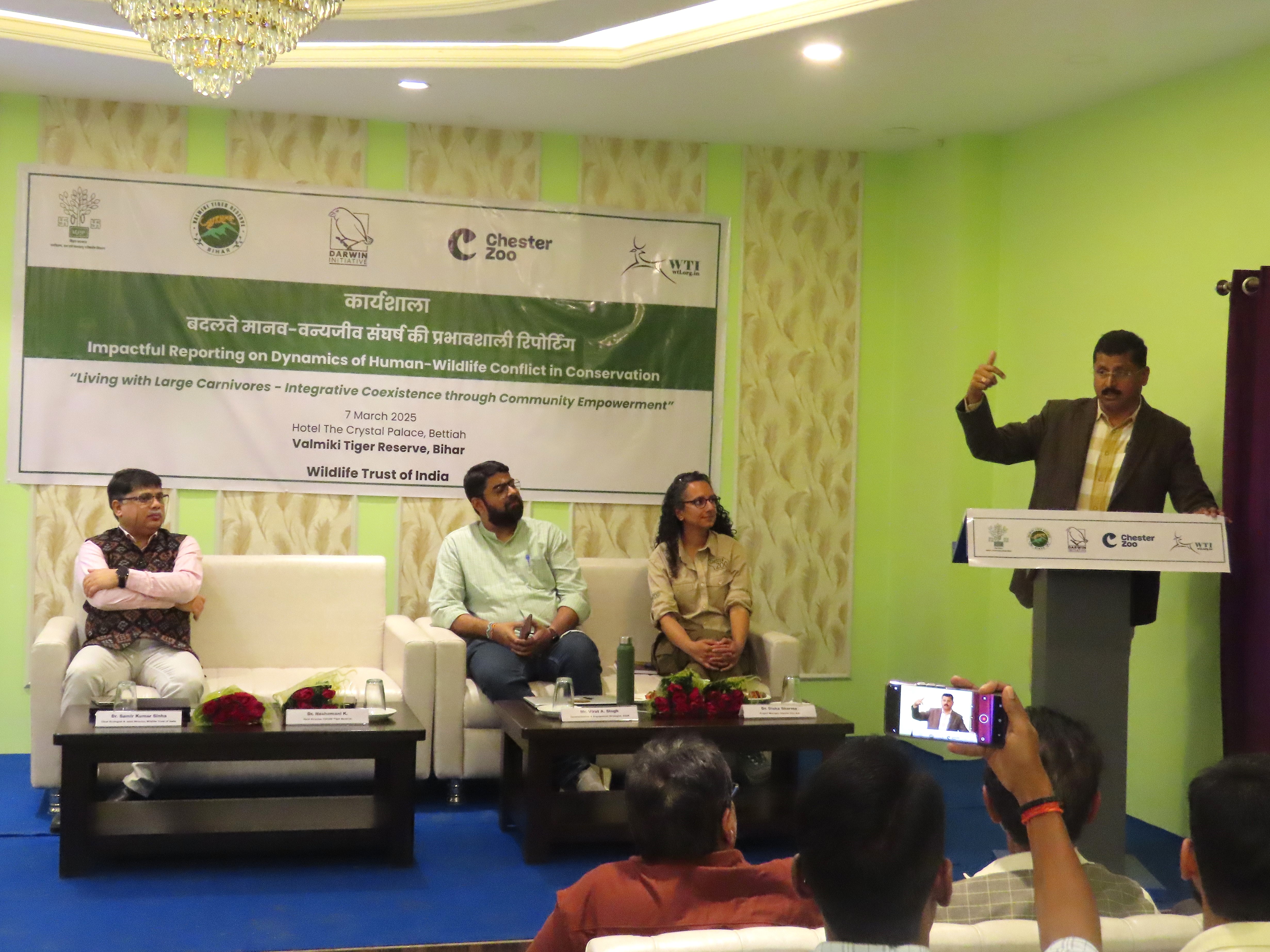
The Field Director of Valmiki Tiger Reserve addresses media personnel invited to the workshop. Credit – Subrat Behera, Wildlife Trust of India.
Shaping media narratives to promote coexistence between people and large carnivores in India and Nepal
In the Himalayan foothills of Bihar, India, the Valmiki Tiger Reserve is a story of revival. The reserve flanks Nepal’s Chitwan and Parsa National Parks, and together this transboundary protected landscape has become a stronghold for tiger conservation. After years of population decline, dedicated conservation efforts over the past decade have transformed the protection of tigers and their habitat. Once reduced to a mere 10 in 2006, tiger numbers increased to 54 in 2022. Alongside them, 86 leopards now roam this 900 km² mosaic of forests and farmland.
With recovery, however, comes a challenge. As populations of large carnivores rise in the limited space, it is inevitable that there will be increased interactions with communities living along the boundary of the reserve, as they often visit the forest to meet their critical livelihood needs. Consequently, the loss of livestock and human lives are real possibilities for these communities. In such situations, while voluntary support offered by the government can provide relief to affected families, the challenge of sustaining human-large carnivore coexistence remains.
As Valmiki is a protected area in Bihar, incidents of human-large carnivore interactions quickly drew the interest of local and regional media. Their reporting brought conservation issues into the public eye, but narratives often focused on conflict and loss. Too often, stories lacked expert context and risked fuelling fear and antagonism, instead of raising knowledge and awareness, which has long-term implications for the coexistence of people with large carnivores in the area.
Recognising the media’s influence, the ‘Living with Large Carnivores: Integrative Coexistence through Community Empowerment’ project - led by Chester Zoo, and implemented by the Wildlife Trust of India and the National Trust for Nature Conservation in India and Nepal – placed special emphasis on engaging print and digital media journalists with the project.
A detailed content analysis of over 1,200 newspaper stories revealed that 93% of wildlife-related news stories appeared in regional Hindi newspapers, demonstrating the importance of adapting narratives to local audiences. The media report analysis showed that negative reporting was often tied to longer, more descriptive headlines and frequently used sensational words. In contrast, informative and positive reports relied on shorter, more engaging headlines. These insights highlighted the need to support journalists in framing stories in ways that connect with readers while still portraying the perspectives of stakeholders accurately.
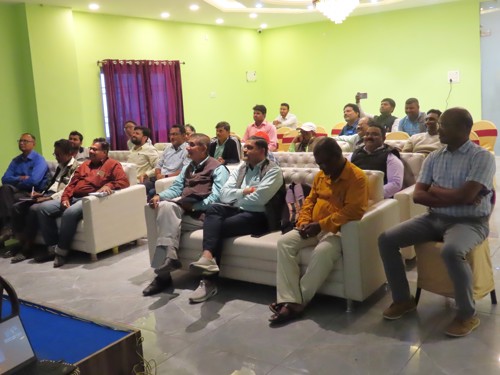
It was decided that a key project intervention would be interacting with media professionals, and a quick perception survey of consenting journalists was undertaken. Encouragingly, most journalists expressed real interest in covering wildlife conservation stories. They also acknowledged their role in raising awareness about human–wildlife interactions and in shaping a positive narrative to promote coexistence. To strengthen this, the project organised workshops, steered by experienced journalists, conservationists, and wildlife managers. In these workshops, invited media personnel from the landscape explored the concept of coexistence and discussed ways of balancing reporting to ensure both people and wildlife are fairly represented.
Workshops quickly sparked enthusiasm. One bureau chief of a Hindi daily newspaper was especially inspired by the project’s initiative of Predator Proof Pens for goats and poultry, specially developed enclosures that prevent predators from killing livestock. Their effectiveness was first proven in Nepal’s Chitwan National Park through a previous Darwin Initiative supported project, ‘Living with Tigers in Nepal: poverty reduction for human-wildlife coexistence', and were then adapted for Valmiki. The bureau chief crafted a headline about Predator Proof Pens that struck a chord with audiences, that translates in English to: "Goats Dare to Stare… The Tiger Stands Watching". Not only did this headline capture readers’ imaginations – of goats living safely despite the presence of predators – but it also boosted beneficiary families’ confidence that their livestock could be protected from carnivore attacks.
"Goats Dare to Stare… The Tiger Stands Watching"
Annual media workshops, with 25-30 media personnel attending them, are now firmly embedded in the project. These interventions show that when journalists are equipped with tools and context, media narratives can shift. In Valmiki, stories are beginning to move away from fear and conflict towards resilience and coexistence.
By engaging local media, the project is not just changing how stories are told; it is helping communities and carnivores share landscapes more sustainably, proving that coexistence is both possible and powerful.
Written by Samir Kumar Sinha. For more information on this Darwin Initiative Main project 30-011, led by North of England Zoological Society (Chester Zoo), please click here.