 Back
Back
Indigenous-led reforestation
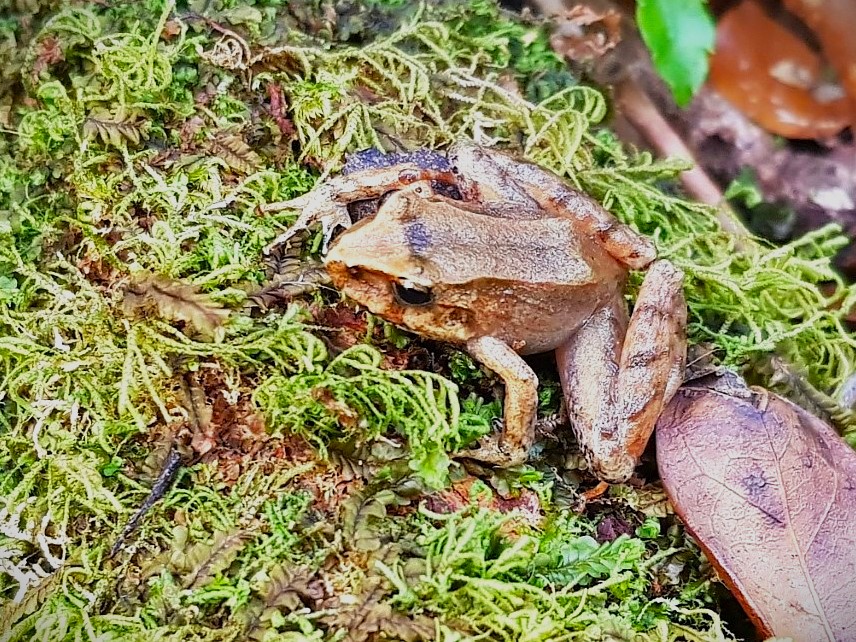
Robber Frog Craugastor brocchi, one of several endemic frogs to the cloud forests of Guatemala. Credit - Jeremy Haggar.
Conserving biological diversity and Indigenous knowledge in the Sierra Yalijux of Guatemala
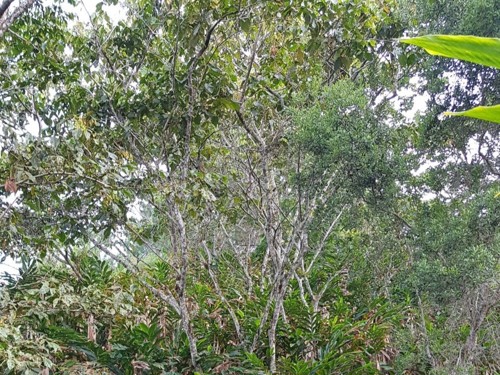
The Sierra Yalijux of Alta Verapaz, Guatemala, is a Key Biodiversity Area and includes sacred hills of the Q’eqchi’ Indigenous People. Working with Q’eqchi’ cooperatives affiliated with partner FEDECOVERA, and private nature reserves through the Association of Private Nature Reserves of Guatemala, we have monitored birds, mammals, amphibians, and reptiles in remanent forest fragments and coffee and cardamon agroforestry systems.
The biodiversity value of Sierra Yalijux has been demonstrated by the presence of four species of regional endemic frogs, and three species of regional endemic salamanders on the IUCN Red List. These include one Critically Endangered species Craugaster daryi, four Vulnerable species Ptychohyla hypomykter, Craugaster xucanebi, Craugaster brochi, and Bolitoglossa helmrichi, plus two Near Threatened species, Bolitoglossa dofleini and Bolitoglossa odennelli.
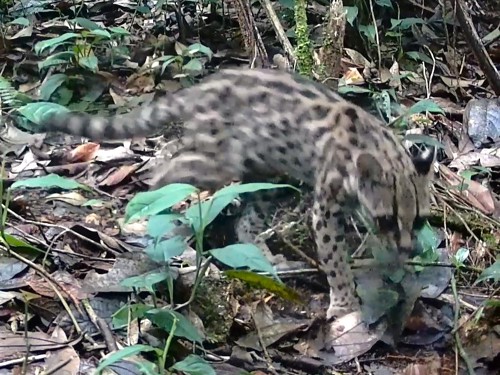
While the Endangered Craugaster daryi and Vulnerable Bolitoglossa odennelli are found in the high-altitude cloud forest of the private nature reserves, the remaining species are found in forest fragments and agroforestry systems in the cooperatives. This shows the importance of conserving these fragments, but also the potential role of sustainable production systems, such as agroforestry, in conservation. Furthermore, images have been captured of three feline species; margay (Leopardus wiedii), ocelot (Leopardus pardalis) and jaguarundi (Herpailurus yagouaroundi). Margays, a Near Threatened species, are the most frequently spotted and widespread in these images, indicating that this region may hold a significant population of this species.
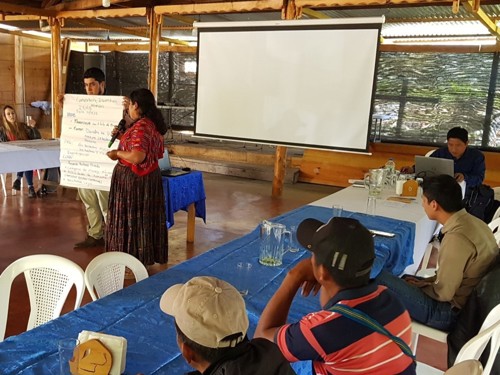
We have also supported ten Q’eqchi’ communities in documenting their Indigenous knowledge associated with nature, formalised as Biocultural Protocols approved by their cooperative assemblies. Nevertheless, the need to provide for their families has driven the Q’eqchi’ communities to deforest a large majority of their land. However, FEDECOVERA has been supporting them to reforest and convert their cardamon production fields (their main source of income) into agroforestry systems. This project, “Indigenous biocultural landscapes for livelihoods and connectivity in Verapaces, Guatemala”, has paid for the trees that were planted across 440 ha of land, while the cooperatives have funded the labour for this reforestation. Additionally, FEDECOVERA have financed another 387 ha of reforestation with funding from the Mastercard Foundation.
The Sierra Yalijux is a high rainfall area that would naturally be covered in rainforest in the lowlands, rising to cloud forest on its mountain tops. However, in 2024 the region experienced an unprecedented drought lasting seven months, affecting water supplies and leading to forest fires. As a result of this, four of the cooperatives agreed amongst themselves to protect a forested ridge along their boundary, establishing fines of approximately £1,000 for anyone felling or lighting fires in this area. To reinforce this, project partners are working with these communities to define two forest conservation areas under Cooperative Management Agreements with the Council for Protected Areas (CONAP), which will cover two of their sacred hills, Cerro Qwa Siyap and Cerro Don Juan. Additionally, an adjacent private farm has agreed to declare their natural forest a private nature reserve adding to the protection along the still forested hilltops.
To promote the broader conservation of the landscape, the project has coordinated a multi-institutional round-table with representation of the cooperatives, private nature reserves, and government institutions. These include the National Institute for Forests, to enable access to reforestation incentive payments, the Guatemalan Institute for Tourism, which is providing training to communities interested in tourism, as well as the Council for Protected Area for updating private nature reserve management plans and conservation agreements.
Furthermore, in the last year the Guatemalan Ministry of Environment and Natural Resources has selected the Sierra Yalijux area for the development of a Biological Corridor. This will provide a permanent forum between project partners FEDECOVERA, the Association of Private Nature Reserves and their members, and the government institutions of the round table, to continue coordination of the conservation of the region after the project concludes.
Written by Jeremy Haggar. For more information on this Darwin Initiative Main project 29-019, led by University of Greenwich, please click here.